Avoiding seabird bycatch is an essential part of responsible longline fishing. Scientific advisory committees such as ACAP, as well as and regional fisheries management organizations such as CCAMLR, issue best-practice-advice that provides guidance and sets out mandatory requirements for the industry to follow.
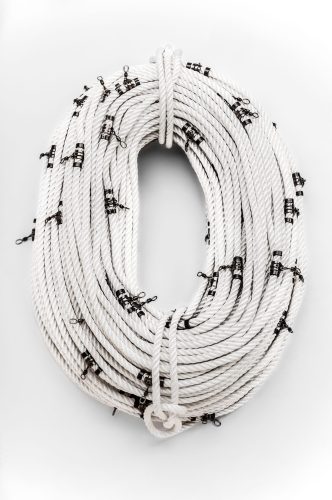
The subsequent adoption of IW lines by the fishing fleet targeting Patagonian toothfish has been hailed as a success in seabird conservation. According to BirdLife International (Bycatch Mitigation Factsheet 3), the use of IW lines “has proved to reduce the bycatch rate of whitechinned petrels by 90%…”.
IW lines begin sinking immediately after entering the water, whereas conventional lines may be held up by propeller turbulence for up to 80 metres astern. IW lines therefore descend rapidly, quickly moving out of the diving range of most seabirds. The difference in sinking rates is illustrated in the diagram.
Streamer lines, or ‘tori’ lines, are another effective measure against seabird bycatch (CCAMLR Conservation Measure 25-02). These consist of fluorescent plastic streamers trailing from specialised lines deployed between a high point on the vessel and a towed object behind the vessel. See BirdLife International Bycatch Mitigation Factsheet 7 for details. A positive side-effect of these seabird conservation measures is improved fishing efficiency. Bait can be partly washed out and lose some of its attractiveness as it travels through the water column.
The fast-sinking IW lines therefore provide more effective fishing time at the target fishing depth, resulting in better bait utilisation.
Further reading: Dietrich, K., Melvin, E., Conquest, L. (2008). Integrated weight longlines with paired streamer lines – Best practice to prevent seabird bycatch in demersal longline fisheries. Biological Conservation, 141, 1793–1805.
Fibre:
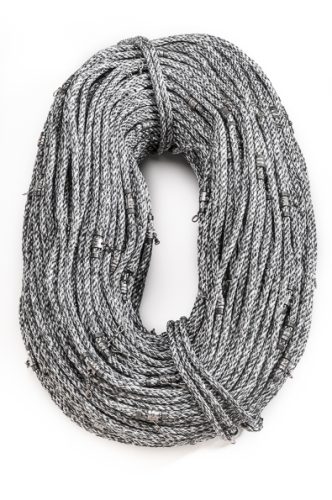
Silver (Polyester-Danline mix)
Spacing:
1.1m to 1.5m. Special spacings upon request
Treatments:
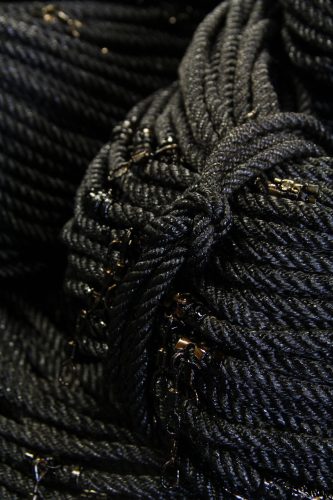
Tar or environment-friendly polyetylene